İstanbul,
16°C
parçalı az bulutlu




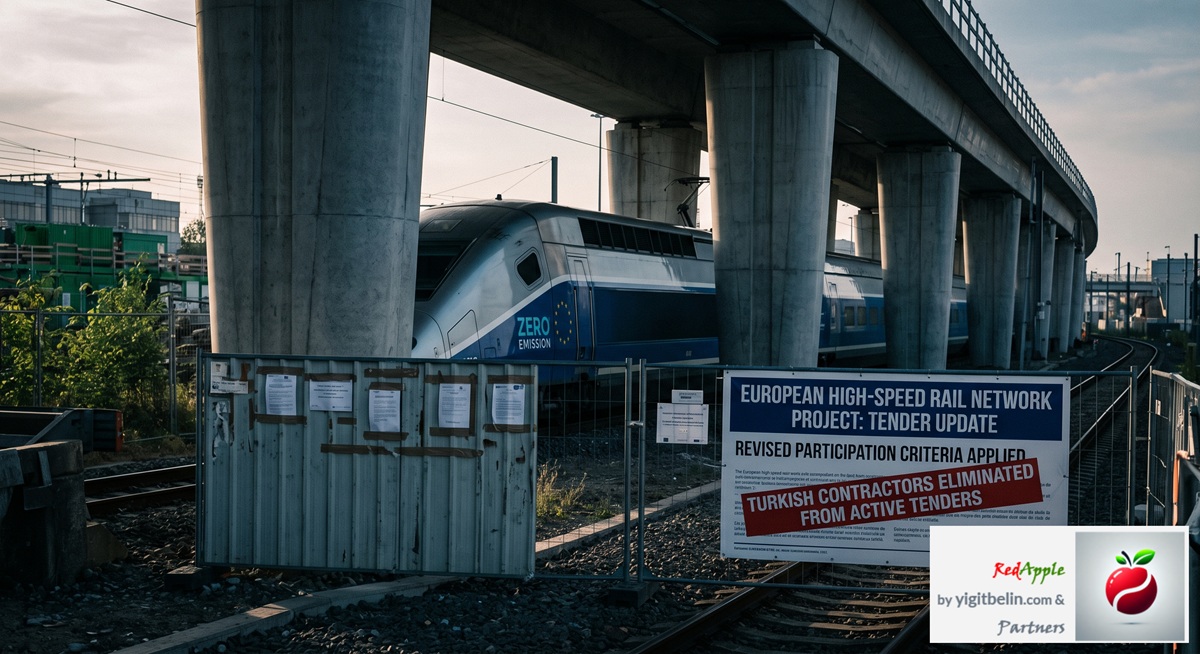
Turkish Companies Shut Out of EU Tenders No One Has to Explain Why! Three rulings since October 2024 — Croatia, Poland, Romania — have redrawn who gets into EU public procurement, and how. The exposure does not stop at the Turkish border: it runs through European consortia and supply chains. The next cycle will belong to whoever structures for the new rules first.
Croatia. Kolin — one of Türkiye’s largest contractors — watched a €227.4 million rail contract go to a competitor. When the dispute reached the Court of Justice of the European Union in October 2024 , the answer was categorical: a bidder from a third country without a reciprocal procurement agreement with the EU has no right to demand equal treatment under the procurement directives.
Poland. In June 2026, Bozankaya — its trams already carrying passengers in Timișoara and Iași — was removed from regional operator Koleje Dolnośląskie’s tender for up to 20 zero-emission trains. Pesa, Siemens Mobility and Škoda advanced. The grounds were not the offer; they were the country. Under Polish rules implementing EU law since September 2025, no case-by-case assessment is required.
Romania. On 13 July 2026, Bozankaya’s challenge in Ploiești’s €50 million tender for 20 new trams was thrown out as inadmissible. Final; no further appeal. The merits were never examined — the reasoned judgment has not even been published. Astra Vagoane Călători will now proceed to contract.
First they lost protection. Then they lost tenders. Now they are losing the right to be heard.
I ran the numbers on the Kolin file alone: €213 million in direct losses already on the books, €1.3 billion in blocked project volume. One company, one country.
And this is bigger than rail. The same instruments reach every sector selling into EU public contracts — and they reach deep into the supply chain. In Lisbon in spring 2026, a consortium kept its place in a light-rail project only after replacing its Chinese vehicle supplier under the EU’s Foreign Subsidies Regulation. The bidder of record was European. The exposure was not.
Rail simply produced the first casualties.
Here is what almost no one has priced in yet: none of this is a verdict on capability.
The manufacturer excluded in Poland delivered its 34th tram to Iași in April 2026 — ahead of schedule — and is currently producing for Naples. The same company is shut out of one procedure and indispensable in the next. What changes between the two is not the product. It is the structure: which procedure, which financing story, which origin file, which role — lead bidder, consortium member, subcontractor, supplier — all decided before the bid is written.
Look again at Romania. The decisive move did not come from a ministry or from Brussels. It came from a European competitor, and it was procedural: a route to court, a question of admissibility, a final ruling.
That is the useful, uncomfortable truth of the new regime. Reciprocity, foreign-subsidy screening, admissibility — these are not abstract policy debates. They are levers. They decide who is in the room, whose price is credible, whose challenge survives. And they operate from either side of the table.
For European companies, the calculation now runs in both directions. A proven, well-priced third-country partner is still a real advantage — extra capacity, competitive technology, delivery references already running in EU cities — if its role, origin file and financing story are structured to survive scrutiny. Structured casually, the same partner becomes the weak point a rival will test first.
The winners of the next procurement cycle are being decided right now — quietly, in structuring choices most companies do not even know they are making: which entity bids, how its financing is explained, where its value is created, which role survives scrutiny.
Whether this pattern hardens or reverses will be decided the same way. Not by protest. By design. The levers exist. Few know where they are — and the companies that learn them first, on either side of the table, will quietly set the terms for everyone else.
Yiğit Belin advises companies on EU procurement access, bid structuring and origin design. His full structural analysis of the three cases is available here.
Yiğit Belin – yigitbelin.com
Red Apple Co. -redapple.world